


A team from Usal is developing software that allows the 3D recreation of events in any type of accident. The project has received the Spanish Police Foundation Research Award.
DIGITAL RECREATION OF THE CRIME SCENE
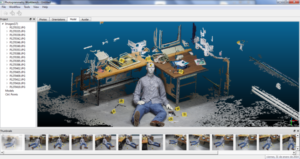 The use of new technologies to automate and modernise many professions has been a constant in recent years, even more so since the emergence of smartphones and tablets. With the aim of making tasks easier, a multitude of projects and initiatives have emerged, such as ‘Forensic PW’. This software designed by a group of researchers from the University of Salamanca aims to simplify and reduce the cost of reconstructing the scene of a fire, accident or crime in a simple way through the use of photographs. “From various images of the place we can reproduce what happened in three dimensions,” says Diego González Aguilera, professor who has directed the project. Unlike the systems used until now – computer techniques or laser formats – the revolutionary design “is automatic, objective and flexible”. In addition, the project merges the quality of the numerical methods of photogrammetry with the speed of algorithms from computer vision. The revolutionary initiative has been awarded this week with the Fundación Policía Española Research Award, worth 20,000 euros. “We are very pleased with this distinction because it helps us to continue working to improve the software,” he says. This “totally low-cost” system allows the use of photographs from any camera, including mobile phones, making it easier to use. In this way, the ‘Forensic PW’ collects images from various views to then “position the point from where the photographs were taken” and provides the dimensional analysis of the place. “We are getting a three-dimensional point for each pixel of the image on which to base ourselves,” says González Aguilera. This system aims to be a complementary tool when it comes to determining responsibilities after an accident, or to find out how a crime was committed. The professor acknowledges that the product has been “tested” by the Scientific Police and that the idea of the group of researchers is that “they use it.” However, they say that “everything is very much alive” and that they hope to increase their performance thanks to the award received. After two years of work, the next step is to “make the leap” to new mobile devices and enable images to be “uploaded to the cloud” to be shared and downloaded at a faster speed. A new way of solving the mysteries that escape the eyes of police investigators.

